What to Look For in Car Club Management Software (2026 Buyer's Guide)

If you run a car club, the software you choose does more than host a website. It decides whether renewals happen automatically or fall through the cracks, whether events fill up or fizzle, and whether your club grows or slowly loses touch with its members.
Most clubs choose the wrong tool because they start from the wrong question. They ask "what website builder should we use?" when they should be asking "what system will run our club?" This guide walks through what car club management software actually needs to do, the tools clubs commonly outgrow, and how to match a platform to your club's size and goals.
What car club management software should actually include
A real club platform replaces a stack of disconnected tools with one system. At minimum, look for:
- A membership database — sign-ups, renewals, tiered membership levels, and automatic expiration tracking so nothing falls through the cracks.
- Integrated online payments — dues and event fees collected in one place, not bounced through a separate payment processor your members have to figure out.
- Event management — registration, ticketing, waitlists, capacity limits, and automated reminders so your officers aren't sending emails manually at midnight.
- Communication tools — announcements, push notifications, and a searchable member forum where the community lives between events.
- A member and vehicle directory — ideally built around the cars themselves, not just names and email addresses.
- A website and content system — so your public face and your member tools live together under one roof, not on separate platforms you maintain separately.
- Mobile-first access — most members will check in, register for events, and browse the forum from their phones. If the platform doesn't work well on mobile, they won't use it.
- Data ownership — you should own your member list, your event history, and your content. Platforms that hold your data hostage when you want to leave are a significant risk.
The magic isn't any single feature in isolation. It's that they're all connected. When a new member joins, they should instantly appear in the directory, gain forum access, and show up eligible for your next event roster — with no officer touching a spreadsheet.
Why generic tools fall short for car clubs
Plenty of general membership platforms exist, and clubs often start there. The problem is that most were built for chambers of commerce, HOAs, and nonprofits — not for automotive culture. That mismatch shows up quickly:
- No vehicle-centric profiles. A car club without car profiles is missing the whole point. Members want to show off their builds, log their mods, and share their history — not just fill in their name and address.
- Weak community features. Generic platforms treat members as line items in a database, not as an active community that wants to talk between events. You end up patching in a Discord server or Facebook group to compensate, which splits your community across platforms.
- Templates that look corporate. Your club's website should look like a car club, not an insurance portal or a condo association newsletter. Generic templates communicate the wrong energy to the enthusiasts you're trying to recruit.
- Plugin sprawl. WordPress-based setups can technically do everything — but only by stitching together a dozen separate plugins you then have to maintain, update, and troubleshoot when they conflict. That's a part-time IT job, not a club management solution.
- No understanding of automotive context. Features like a digital garage — where members log builds, document mods, and share their vehicle history — are exactly the kind of automotive-first tool generic platforms simply don't offer. And it's often what keeps members logging in between meets.
The four categories of tools clubs consider
When you research options, they tend to fall into a few buckets. Understanding the categories matters more than memorizing a list of brand names:
- General membership platforms — Broad tools like Wild Apricot or ClubExpress. Capable, but built for generic nonprofits. You end up adapting your club to the software rather than the reverse.
- Event-focused platforms — Tools like MotorsportReg that handle registration well but don't run the rest of your club. You still need separate solutions for everything else.
- Community platforms — Discord and Facebook Groups. Great for real-time chatter, but they can't manage dues, track renewals, or own your member data. And your reach is controlled by someone else's algorithm.
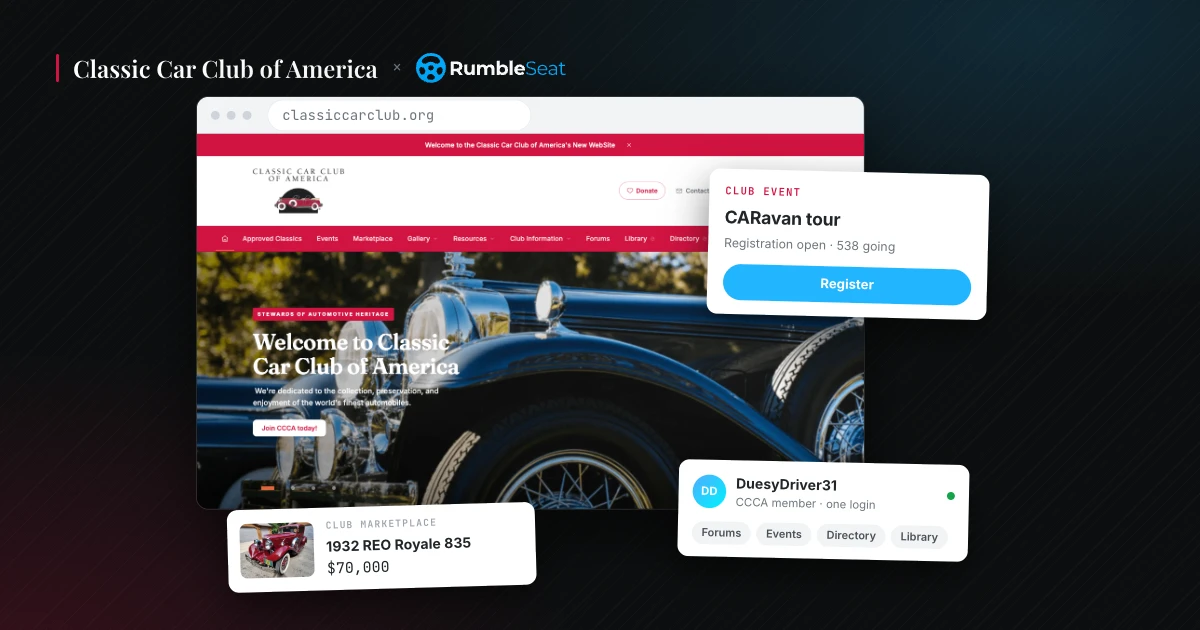
- Dedicated car club platforms — Purpose-built car club management software like RumbleSeat that combines membership, payments, events, community, and vehicle profiles in one automotive-first product.
The trade-off is breadth versus fit. Generic tools give you breadth; dedicated platforms give you fit. Here's how they stack up across the features that matter most:
| Feature | RumbleSeat | General Platforms | Event Tools | Community Tools |
|---|---|---|---|---|
| Membership management | ✓ | ✓ | ✗ | ✗ |
| Integrated payments | ✓ | ✓ | Partial | ✗ |
| Event registration | ✓ | Partial | ✓ | ✗ |
| Member forums & community | ✓ | Partial | ✗ | ✓ |
| Vehicle / build profiles | ✓ | ✗ | ✗ | ✗ |
| Automotive-first design | ✓ | ✗ | Partial | ✗ |
| Multiple membership tiers | ✓ | ✓ | ✗ | ✗ |
| All-in-one (no plugins) | ✓ | ✗ | ✗ | ✗ |
Swipe to compare
Want named products rather than categories? Our best car club software comparison reviews seven platforms, including Wild Apricot, ClubExpress and MemberDay, on pricing and features.
Match the platform to your club's size
The right choice depends heavily on where your club is right now — and where you want it to be in three years.
Small clubs (under 50 members)
Your priority is getting off spreadsheets and Facebook without adding new administrative overhead. Look for a platform with simple sign-up flows, straightforward dues collection, and low maintenance requirements. You shouldn't need an IT volunteer to keep the lights on. The key test: can a non-technical officer handle everything without calling for help?
Growing clubs (50–300 members)
Now events and communication start to strain. Manual processes that worked at 40 members break at 120. You need automated renewal reminders, reliable event notifications, and a real member management system so the club doesn't feel chaotic as it scales. This is the stage where clubs most often outgrow their current tools — and where switching costs hurt most if you waited too long.
Large or multi-region clubs (300+ members)
Structure becomes everything at this scale. Look for support for chapters or regional sub-groups, delegated admin roles so officers don't share a single login, and reporting dashboards so leadership can see what's actually happening across the club without having to ask. If you're running a national marque club with regional chapters, you need software that understands that hierarchy — not a workaround built on spreadsheet exports.
Questions to ask before you commit
Before signing up for anything, run the platform through this checklist. Treat every "no" as a red flag worth investigating:
- Is this one centralized system, or plugins stitched together by someone who may or may not still be around to maintain them?
- Are payments built in natively, or do dues run through a separate service your members have to navigate?
- Does it work well on a phone? (Check on an actual phone, not a desktop browser in responsive mode.)
- Can it support tiered membership levels — Associate, Full, Life, Honorary — with different dues and access per tier?
- Can it grow into chapters or regions later without requiring a full platform migration?
- Does it understand cars — vehicle profiles, build logs, automotive community culture — or is it a generic template with your logo on it?
- What happens to your data if you leave? You should own your member list, be able to export it in a standard format, and leave at any time.
- Is there a real support team, or are you posting in a community forum and hoping someone answers?
What about cost?
Car club management software typically falls into three pricing models: per-member fees, flat monthly or annual subscriptions, or transaction fees on dues and event payments. Most clubs find that a flat subscription is the most predictable — and that the time saved on admin alone justifies the cost within the first month.
The real cost comparison isn't software A versus software B. It's software versus the hidden cost of your current system: officer hours spent on manual renewals, events that lose registrations because the process was confusing, members who drift away because they stopped seeing the club as relevant. A platform that eliminates those friction points pays for itself quickly.
"We went from chasing renewals by email every January to having it just happen automatically. That alone saved our membership chair dozens of hours a year."
Frequently asked questions
What is car club management software?
Car club management software is an all-in-one platform that handles everything a club needs to operate: membership sign-ups, dues collection, event registration, communication, and a member directory — all connected in one system. The best platforms are built specifically for automotive culture, not adapted from generic nonprofit tools.
What's the difference between a website builder and car club management software?
A website builder gives you pages to fill in. Car club management software gives you an operating system — membership tools, integrated payments, event management, and community features — with a website included. Clubs almost always need the latter. If you're only looking for a website, you'll find yourself building workarounds for everything else within a year.
Can we just use WordPress?
You can, but you'll be maintaining a collection of plugins for membership, events, payments, and forums — each with its own updates, costs, and failure points. When one plugin breaks another, you're the one debugging it at 11pm before your annual membership drive. A dedicated platform bundles all of that and takes responsibility for maintaining it. See more on this in our pillar piece on why car club websites fail.
Is dedicated car club software worth it over a free Facebook group?
Facebook is free until you count what it costs: no dues management, no owned member data, no searchable history, and reach controlled by an algorithm that can bury your posts for any reason. For a club that wants to grow, retain members, and last beyond the next algorithm change, dedicated software pays for itself. Here's the detailed case if you need to make it to your board.
What features should car club management software have?
At minimum: a membership database with automatic renewals, integrated payment collection for dues and events, event registration software, a member and vehicle directory, communication tools, and a public website — all connected so data flows between them automatically. Beyond the basics, look for vehicle build profiles, multi-tier membership support, and mobile-first design.
Can car club software handle multiple membership tiers?
The best platforms do. You should be able to define different tiers — Associate, Full, Life, Honorary, for example — with different dues amounts, renewal rules, and access permissions per tier. Always confirm this before committing, because retrofitting tier support onto a platform that wasn't designed for it is a painful migration.
Does car club software work for small clubs?
Absolutely — and small clubs often benefit the most from it, because even a 30-person club has enough administrative overhead to drain volunteer energy. The key is choosing a platform with pricing that makes sense at your scale, and a setup process that doesn't require technical expertise to get going.
The bottom line
Don't shop for a website. Shop for the system that will run your club for the next decade. The best car club management software unifies membership, payments, events, and community into one automotive-first platform — so your officers spend less time on admin and more time doing what the club actually exists to do.
For a deeper look at what separates clubs that thrive from clubs that stagnate, start with Why Most Car Club Websites Fail. When you're ready to see what this looks like in practice, explore how RumbleSeat runs a club from end to end.
Powered by RumbleSeat — the all-in-one platform for car clubs, digital garages, and the automotive marketplace.
Start your club free