Facebook Groups vs. a Dedicated Car Club Website: Which Does Your Club Need?
Almost every car club starts the same way: someone spins up a Facebook group, invites the crew, and it works — for a while. Then dues need collecting, an event needs organizing, and three years of photos vanish into an endless feed. That's when the cracks show.
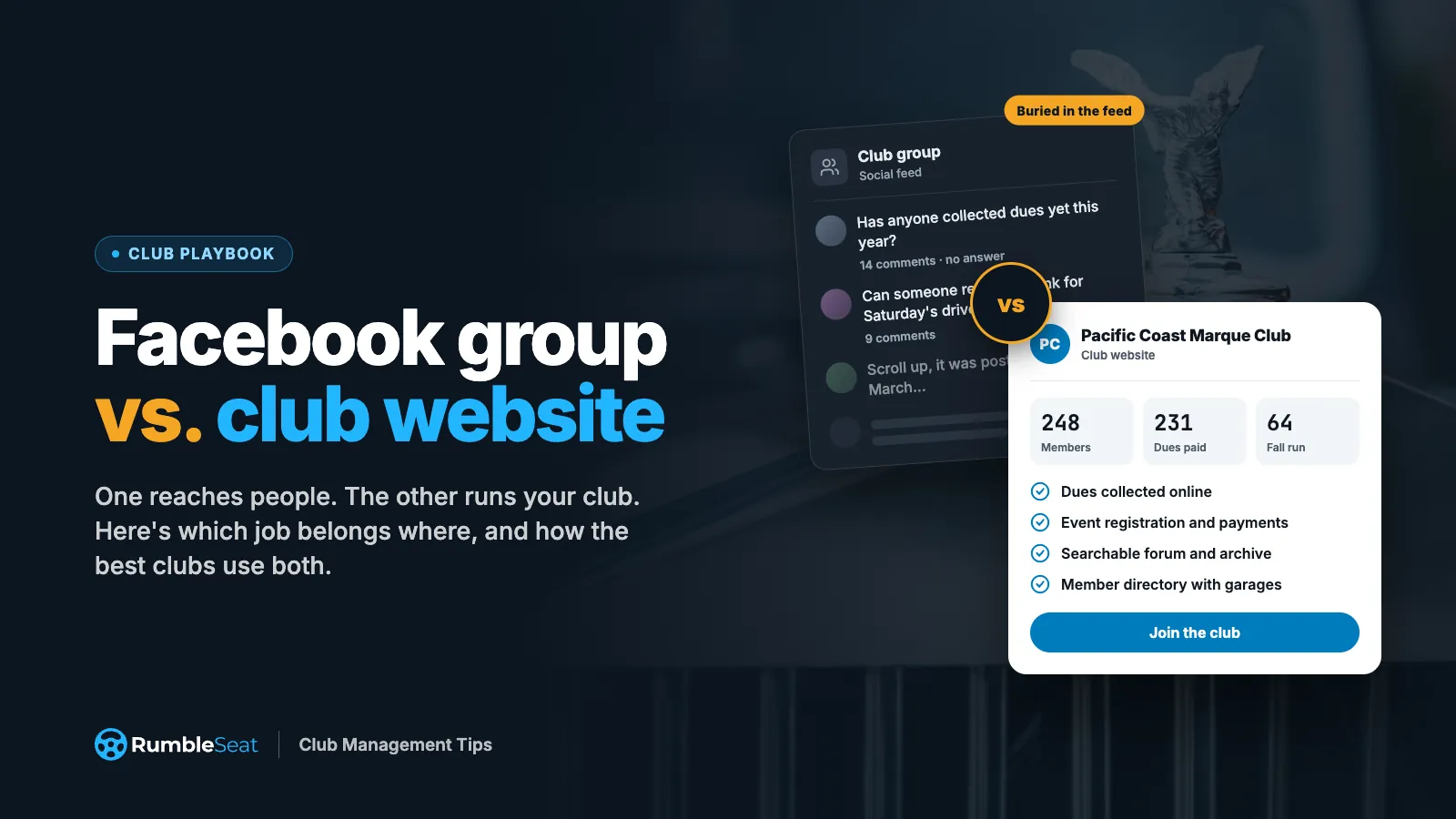
So which does your club actually need: a Facebook group or a dedicated car club website? The honest answer is that they do different jobs. This comparison lays out where each wins, where each falls short, and how the best clubs use both.
The quick verdict
- Facebook groups are excellent for reaching people and casual chatter. They're free, familiar, and where enthusiasts already hang out.
- Dedicated car club websites are built for running a club — dues, membership data, events, and history you actually own.
Most successful clubs use Facebook as a front door and a real website as their headquarters. Relying on Facebook alone is where clubs get stuck.
Where Facebook groups win
Give Facebook its due. A car club Facebook group is genuinely good at a few things:
- Free and fast to set up. Anyone can start one in minutes.
- Built-in reach. Enthusiasts are already there, and a public group can be found by people who aren't members yet.
- Familiar, frictionless chatter. Comments, reactions, and quick photo dumps are effortless.
- Discovery. People find clubs through Facebook's search and group suggestions.
For casual conversation and first contact with potential members, it's hard to beat.
Where Facebook groups fail a car club
The problems appear the moment your club needs to operate as an organization rather than a chat room:
- No paid-member tracking. Facebook shows who's in the group and lets admins ask approval questions, but you can't track who's a paid member, what tier they're on, or when they renew — the basics of managing car club members.
- No built-in way to collect dues. There's no way to collect dues or track who's paid inside the group, so your finances live in a separate tool anyway.
- Content disappears. Posts sink in the feed fast and are hard to find later.
- You don't own it. Facebook controls the platform, the rules, and how your posts are shown — and can change any of it.
- The feed decides who sees what. Your announcement may reach only part of the group, depending on what Facebook chooses to show each member.
- Thin member data. You get a member list, but no club profiles, no vehicle data, and no reliable way to segment or contact members.
- History is hard to use. Years of events and build threads become a long scroll instead of an archive.
In short: Facebook is a great place to talk, and a terrible place to run anything. If you want the longer version, we've made the full case against running a club on Facebook alone.
Where a dedicated car club website wins
A purpose-built car club website exists to do exactly what Facebook can't:
- Membership management — sign-ups, tiers, renewals, and dues collection on autopilot
- Integrated payments — dues and event fees handled in one place
- Event tools — online registration, capacity limits, and paid events
- A searchable forum — a permanent, organized knowledge base instead of a feed
- A member directory — with vehicle-centric profiles and a digital garage
- Ownership — your data, your community, your history, on your terms
- A lasting archive — events, photos, and build logs you can actually navigate years later
The trade-off is that a website takes a bit more setup than clicking "Create group." Modern car club management software narrows that gap by bundling the website, membership, dues, and events into one platform, so you aren't building anything from scratch. If you're comparing platforms, here's what to look for in car club management software.
Facebook group vs. car club website: side-by-side comparison
| Capability | Facebook group | Dedicated car club website |
|---|---|---|
| Cost to start | Free | Varies — monthly subscription or per-transaction fees |
| Reach & discovery | Excellent | Moderate (you drive traffic) |
| Membership tracking | No paid-member tracking, tiers or renewals | Full — tiers, renewals |
| Collect dues / payments | No built-in way to collect dues or track who's paid | Yes, integrated |
| Event registration | Basic RSVP | Full — registration, capacity limits, payments |
| Searchable history | Poor | Yes — organized archive |
| Member directory | Member list only — no profiles or vehicle data | Yes — with vehicle profiles |
| You own the data | No — it's on Facebook's terms | Yes |
| Algorithm limits reach | Yes | No |
The best approach: use both
You don't have to choose. The clubs that grow use each tool for what it's good at:
- Facebook group — casual chatter, reaching new enthusiasts, and quick discovery. Treat it as your billboard and front porch.
- Dedicated website — the actual club: dues, members, events, forums, and history. Treat it as your headquarters.
Point your Facebook posts toward your website's membership sign-up and event pages, and you get Facebook's reach without depending on it for the things it can't do.
How to move your club beyond a Facebook-only setup
You don't need a big-bang migration. Most clubs make the shift in a few deliberate steps:
- Pick a platform built for clubs. Look for membership, dues, events, and a website in one place, so you aren't stitching tools together.
- Bring your members over. Import your current roster or invite members by email, and ask everyone to fill out a profile.
- Move dues and your next event first. These are the jobs Facebook can't do, so they give members a reason to log in right away.
- Pin a post in your Facebook group. Point it to the new site for joining, renewing, and registering, and repeat the link whenever you announce an event.
- Keep the group for chatter. Let Facebook stay the place for quick photos and conversation while the website handles the club's business.
Frequently asked questions
What's the difference between a Facebook group and a car club website?
A Facebook group is a free discussion space on Facebook's platform, built for conversation and reach. A car club website is your club's own home base, built to run the club: membership, dues, events, and an archive you control. Most clubs get the best results by using the group to reach people and the website to run the club.
Can I run a car club with just a Facebook group?
You can start one, but you'll quickly hit walls: no built-in dues collection, no real member data, hard-to-search history, and no ownership. Clubs usually feel those limits as soon as they start collecting dues or running regular events.
Is a car club website worth paying for when Facebook is free?
Facebook is free until you count what it can't do. If your club collects dues, runs events, or wants to last, a dedicated website can pay for itself in saved admin time and better retention.
Do I have to shut down my Facebook group if I get a website?
No — keep it. Use it for reach and casual conversation, and drive people to your website to actually join and register for events.
The bottom line
Facebook groups and dedicated car club websites aren't really competitors — they're a front door and a headquarters. Facebook reaches people; a website runs your club. Rely on Facebook alone and you'll hit a ceiling on dues, events, data, and history.
Use both, with your website doing the heavy lifting. To understand what that website needs to do, start with why most car club websites fail.
Powered by RumbleSeat — the all-in-one platform for car clubs, digital garages, and the automotive marketplace.
Start your club