How to Write Car Club Bylaws (Free Template + Generator)
Every strong car club runs on more than good cars and good people. It runs on a clear set of rules that everyone agreed to before anyone needed them.
Nobody starts a car club because they're excited to write bylaws. You start it because you love the cars and the people. Sooner or later, though, something happens: a disputed election, a member who won't stop selling parts in the group chat, or a treasurer who moves away with the only bank login. That's when you find out the club needed a rulebook all along.
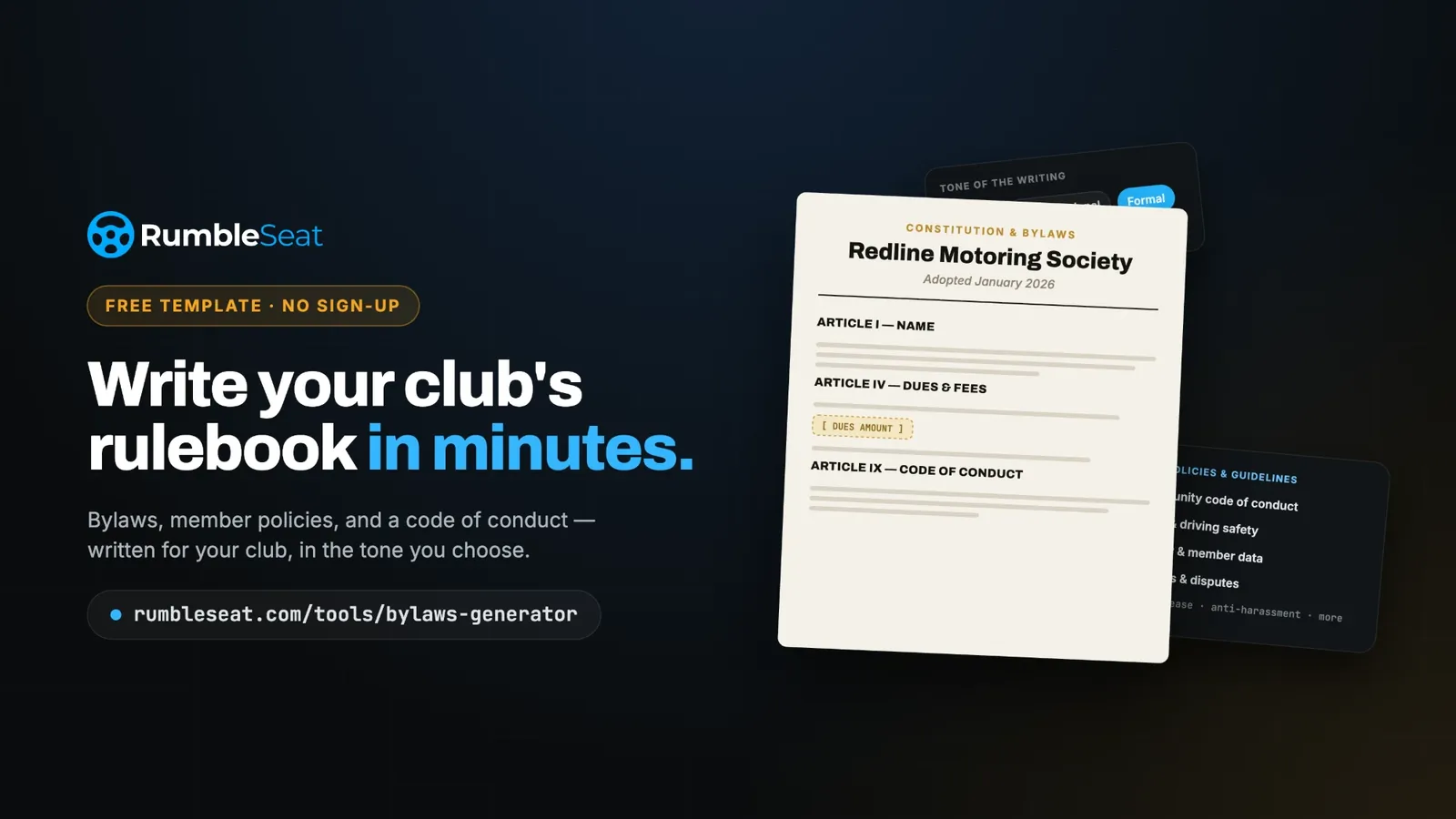
The good news is that writing one doesn't mean starting from a blank page or paying a lawyer to draft it. This guide covers what belongs in car club bylaws, what belongs in your member policies and code of conduct, and how to get the whole thing adopted. When you're ready to write, our free car club bylaws generator drafts a complete, ready-to-adapt document from a few details about your club, in the tone you choose. You don't need an account.
Skip the blank page. Fill in a few details, pick a tone, and get a complete car club bylaws template to copy, print, or download as a Word file: open the free bylaws generator.
What are car club bylaws?
Car club bylaws are the written rules for how your club is organized and run. They name the club, state its purpose, define who can join, set the officer roles and how they're elected, explain how money is handled, and spell out how the rules themselves can change. When a question comes up about who decides something, the bylaws should already have the answer.
Some clubs call this document a constitution, some call it bylaws, and some keep two separate documents. In a large organization the constitution sets the club's fundamental identity and the bylaws hold the operating detail. For most car clubs a single combined "constitution and bylaws" document works well and is easier to maintain. That's the format the generator produces.
Bylaws vs. member policies: what's the difference?
People use "bylaws" to mean everything, but a healthy club really has two documents, and they do different jobs.
- Constitution & bylaws govern how the club is run: its name, who can join, how officers are elected, how money is handled, and how the rules get changed. This is your structure.
- Member policies & guidelines govern how members behave: the code of conduct, event and driving safety, privacy, refunds, photography, and how disputes get resolved. This is your culture, written down.
You want both. Bylaws keep the organization legitimate and stable, and policies keep events safe and the community healthy. A club with bylaws but no code of conduct is one bad Saturday away from a problem it never defined how to handle.
What to include in car club bylaws: the 12 essential articles
Think of bylaws as answering every "who decides?" question in advance. A complete set of car club bylaws covers these twelve articles:
- Name. The club's official name, home location, and founding year.
- Purpose. What the club exists to do (drives, shows, preservation, charity), and the fact that it runs not-for-profit for its members.
- Membership. Who's eligible, how someone joins, the classes of membership you offer, and what "in good standing" means.
- Dues & fees. Your membership tiers and prices, when dues are payable, and how the amounts get changed. Not sure what to charge? Our car club cost calculator turns your expenses into a per-member figure.
- Officers & duties. The roles (usually President, Vice President, Secretary and Treasurer) and what each one is responsible for.
- Elections & terms. How officers are elected, how long they serve, and how a seat that opens mid-term gets filled.
- Meetings & quorum. How often the club meets, how much notice members get, and how many members must be present to make decisions.
- Committees. How the board can set up event, membership, or communications committees.
- Code of conduct. The baseline behavior expected of members. The detail lives in your member policies.
- Finances. How funds are recorded, held, spent, and reported, including who can sign or approve payments.
- Amendments. The vote and the advance notice required to change the bylaws themselves.
- Dissolution. What happens to the club's money and assets if it ever winds down.
Leave any one of these out and a future disagreement will find the gap. The bylaws generator writes all twelve, filled in with your club's name, membership tiers, meeting schedule, and vehicle focus.
Getting the numbers right
A few clauses carry numbers, and those are where clubs most often get stuck:
- Quorum. Set it at a number you can actually reach. If quorum is half the membership and a typical meeting draws a quarter, you can never make an official decision. Many clubs use a fixed number or a modest percentage of members in good standing.
- Amendment threshold. A two-thirds vote with advance written notice is a common standard. It's high enough that the rules can't be rewritten on a whim and low enough that a club can still update them.
- Terms of office. One- or two-year terms are typical. Staggering them so the whole board doesn't turn over at once keeps knowledge in the club.
- Financial controls. Requiring two people to approve large payments, and giving more than one officer access to the bank account, protects both the club and the treasurer.
Car club member policies and code of conduct
If bylaws are the skeleton, member policies are the muscle, and they're the part most clubs don't write down until something goes wrong. A solid set of car club policies and guidelines covers:
- Community code of conduct. Respect in person and online, with zero tolerance for harassment, discrimination, or abuse, whatever someone drives and however long they've been a member.
- Membership & good standing. What members are expected to do to stay in good standing, and what happens when they don't.
- Guests & prospective members. Who can attend events before joining and what's expected of them.
- Event & driving safety. Obey traffic laws and posted limits, follow the organizers' instructions, and never street race, drive recklessly, or drive impaired at a club event.
- Payments, dues & refunds. How dues and event payments work and when refunds are given.
- Communications & social media. The ground rules for the club's group chats, forums, and social accounts, including buying and selling.
- Privacy & member information. What member information the club collects, how it's used, and that it's never sold.
- Photography & media. That photos taken at club events may be used in club communications, and how a member can opt out.
- Concerns & disputes. How to raise a complaint, who handles it, and the consequences when the code of conduct is broken.
These policies set expectations for new members on day one. They protect the club and its officers when something goes wrong. And they make hard conversations easier, because the rule was already written and agreed to, not invented in the heat of the moment. The generator writes this document too: use the switcher at the top to flip from your constitution & bylaws to your member policies & guidelines.
Pick a tone that sounds like your club
Most bylaws templates get one thing wrong: they force a stiff, legalistic voice onto clubs that are anything but. A weekend cars-and-coffee crew shouldn't have to adopt a rulebook full of "heretofore" and "the party of the first part."
That's why the generator lets you choose the tone, and the tone changes how every clause is written, not just the introduction:
- Formal. Traditional legal phrasing with "shall" and numbered articles. The classic bylaws style.
- Mature. Professional and businesslike, without the archaic language.
- Conversational. Friendly and clear, written as "we" and "you."
- Casual. Relaxed and plain-spoken, like a founding member talking, not a lawyer.
It's the same complete structure in four different voices, so your rulebook can be airtight and sound like your club.
How to use the free car club bylaws generator
- Choose your document. Start with your constitution & bylaws or your member policies & guidelines, and switch between them at any time.
- Fill in a few details. Club name, location, founding year, vehicle focus, purpose, membership tiers and dues, and meeting schedule. Every field is optional.
- Pick your tone. Formal, mature, conversational, or casual.
- Copy, print, or download. The document builds as you type. Anything you leave blank is marked as a highlighted placeholder like [DUES AMOUNT], so you know exactly what's left to decide. Download it as a Word file to edit in Word, Google Docs, or Pages.
It's free and doesn't require an account. Write your club's rulebook now.
How to adopt your car club bylaws
A draft isn't a rulebook until the club agrees to it. Here's a simple way to get from a generated document to adopted bylaws:
- Draft with your founding group. Generate a first version, then have two or three founding members fill in the placeholders and adjust anything that doesn't fit how your club works.
- Circulate it before the vote. Send the draft to every member with enough notice to read it, at least a couple of weeks before the meeting where you'll vote.
- Vote at a meeting. Discuss any changes, then vote to adopt. Record the date and the result in the meeting minutes.
- Sign and date it. Have the President and Secretary sign the adopted copy and note the adoption date at the top.
- Publish it where members can find it. Members should be able to read the current rules whenever they need them, not dig through an old email.
- Review it every year. Put a quick bylaws review on one meeting agenda a year, and amend it using the process your own amendments article describes.
Starting a club from scratch? Bylaws are one step in our guide on how to start a car club, and our checklist for running a car club covers what comes after.
Common mistakes to avoid
- Copying another club's bylaws word for word. Their quorum, dues, and officer roles were set for their club, not yours.
- Making it too detailed. Put the things that rarely change in the bylaws, and keep event rules, dues amounts, and procedures in policies the board can update more easily.
- Setting thresholds you can't meet. An unreachable quorum or amendment vote freezes the club.
- Leaving out dissolution. Nobody plans to wind down, but deciding in advance where the money goes prevents an ugly argument later.
- Never writing a code of conduct. Without one, every incident becomes a debate about whether there was a rule at all.
A quick note: the generator gives you a solid starting template, not legal advice. Laws vary by state and by the kind of organization you are. If your club handles significant money or plans to apply for tax-exempt status, have an attorney or accountant review your final documents.
From a document to a running club
A rulebook is the foundation, not the finish line. Once your bylaws and policies are set, RumbleSeat gives your club a place to put them to work: a club website to publish them, a roster that tracks members in good standing, dues collection that matches your membership tiers, and event tools that put your safety policy into practice. Your club site even has a Club Policies & Guidelines page in the footer, so you can paste in what you generate and it's live for every member.
When you're ready, you can create your club on RumbleSeat. There's no setup fee: Standard has no monthly fee and a 4.9% platform fee plus card processing when your club collects money, and Club Pro is $59 a month with a 1% fee.
Write the rules once, agree on them together, and get back to the part you actually signed up for: the cars, and the people who love them.
Frequently asked questions
Do car clubs legally need bylaws?
An informal group of friends doesn't. But once your club collects dues, opens a bank account, holds events open to the public, or applies for nonprofit or tax-exempt status, written bylaws protect the club and its officers. Banks and insurers often ask to see them.
What's the difference between a car club constitution and bylaws?
Traditionally, a constitution sets out the club's fundamental identity (its name, purpose, and membership), and the bylaws hold the operating rules (officers, elections, meetings, and finances). Most car clubs combine them into a single "constitution and bylaws" document, which is what the generator produces.
What's the difference between bylaws and a code of conduct?
Bylaws govern how the club is organized and run, such as officers, dues, and voting. A code of conduct is a member policy that governs behavior at events and online. You want both.
How do you adopt or change car club bylaws?
Circulate the draft to members ahead of time, then vote to adopt it at a meeting and record the result in the minutes. After that, change them only through the process in your amendments article, which is commonly a two-thirds vote with advance written notice.
Can I change the tone of the generated bylaws?
Yes. Choose formal, mature, conversational, or casual. The structure stays complete, and the wording of every clause changes to match your club.
Is the car club bylaws generator really free?
Yes. It's free, with no account or email required. Copy it, print it, or download it as a Word file as many times as you need.
What should car club dues be?
That depends on your costs. Use the free car club cost calculator to add up your expenses and see a recommended per-member figure, read our breakdown of a car club budget, and then set your tiers in the bylaws generator.
Powered by RumbleSeat — the all-in-one platform for car clubs, digital garages, and the automotive marketplace.
Start your club